University of California Santa Barbara (UCSB) Physics professors John Martinis and Micahel Devoret received the 2025 Nobel Prize in Physics on Oct. 7. Physicist John Clark of UC Berkeley also shared the honor. They were awarded for their work with superconductors that helped lay the foundation for revolutionary quantum computing in the years to come.
UCSB Chancellor Dennis Assanis’ statement was read the following day at a press conference hosted at the university. Assanis wrote about the physicists, “Your revolutionary work in quantum tunneling has been well known for over three decades. You’ve paved the way for components found in everyday devices and major advancements in communication, computing, and sensing.”
A computer that people are accustomed to using includes a part called the Central Processing Unit (CPU). The CPU acts akin to a brain in the computer, allowing it to follow instructions and make calculations. A typical CPU is made mostly of the semiconductor silicon. A semiconductor is a material that can conduct electricity between a conductor and an insulator. The purified silicon is formed into large thin wafers that are layered; in between lies billions of microscopic transistors that form complex circuits such as the arithmetic logic unit (ALU) and the control unit.
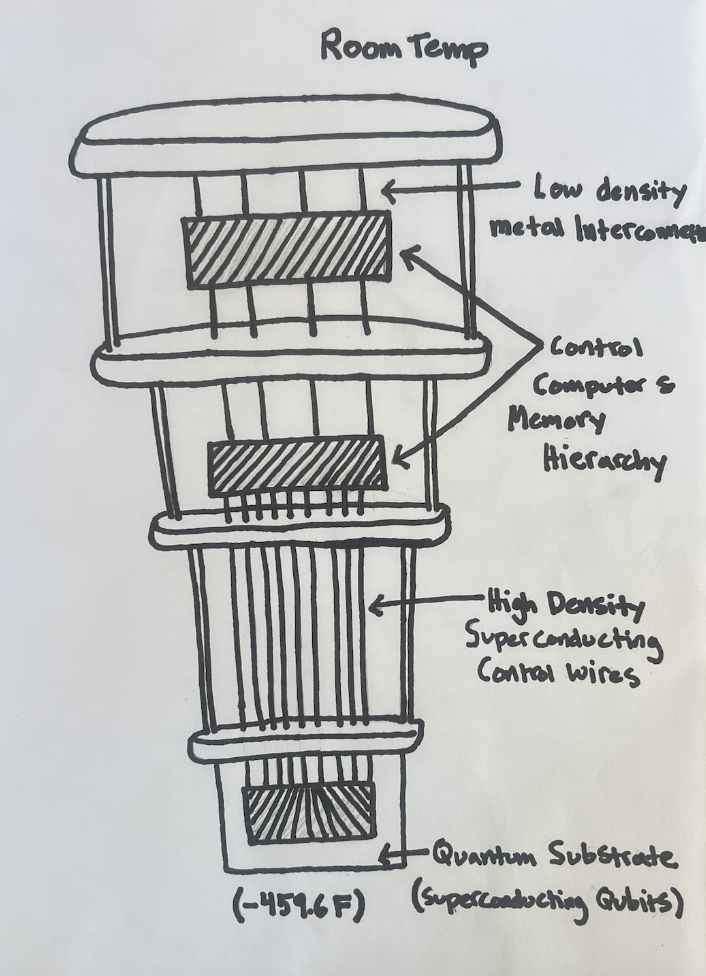
A quantum computer works a bit differently. Its processor is referred to as the quantum computer processor (QPU) and is made with superconductors instead of semiconductors, allowing for more electric conductivity than previously possible, and thus more powerful computing.
Martinis, Devoret, and Clark worked on key experimentation with superconductors in 1984 and 85. The experiment consisted of creating a circuit of two separated superconducting layers making it possible for superconducting electrons to ‘tunnel’ through. This is known as a Josephson junction, coined after the British physicist Brian D. Josephson, a Nobel Prize Physics winner himself in 1973.
Superconductors are materials that conduct electricity without resistance, allowing the current to flow with zero energy loss. Superconductors are critical parts of the engineering used in particle accelerators, electric grids, MRI machines, and, most recently, quantum computing.
In quantum computing, Josephson junctions are superconducting qubits, meaning they are the units of information in the computer. They can be superposed to represent both 0 and 1 and every possibility in between, making them exponentially more powerful than a classical computer qubit stuck at either 0 or 1.
Quantum computing has many different applications in scientific research fields, cybersecurity, artificial intelligence, and machine learning. Google currently has a Quantum computing lab right here in Santa Barbara, which stores advanced quantum processors.