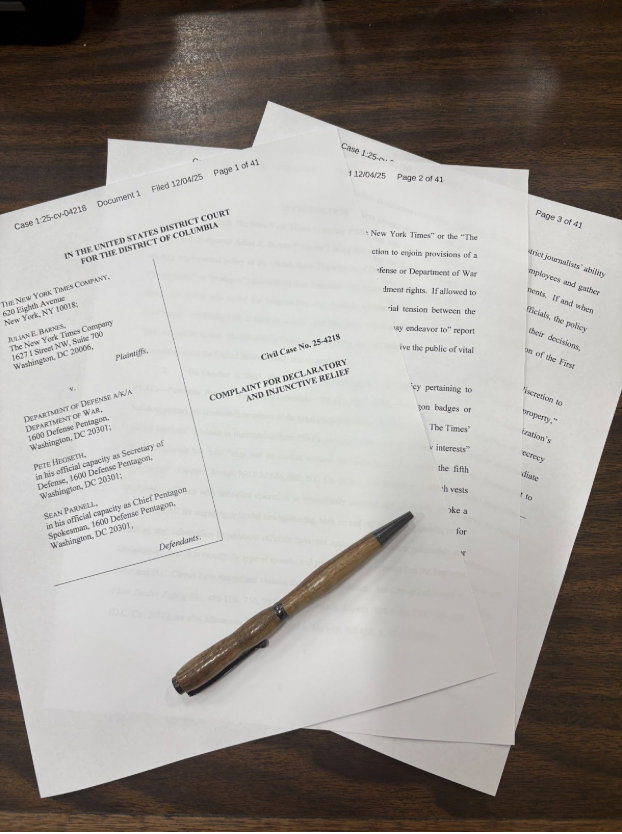
On Dec. 4, the New York Times filed a lawsuit against the Pentagon for “infringing on the constitutional rights of journalists” following a set of rules imposed by Defense Secretary Pete Hegseth and Chief Pentagon Spokesman Sean Parnell about military reporting.
The rules, put in place in October, limit journalists’ access to the Pentagon and ask them to sign a 21-page contract upon entrance. Before this contract, journalists were only asked to fill out a one-page document in order to obtain a press credential, or Pentagon Facility Alternate Credential (PFAC), and agree to background checks, among other security measures. These rules primarily limit journalists from gaining access to coverage of unclassified documents. Through the First Amendment’s freedom of the press, journalists are permitted to report on unclassified documents, unless they are putting the United States at risk during wartime, per the Espionage Act of 1917.
The Times described the new rules as a “stark departure” from the rules set in place previously, identifying that one of the new rules that puts reporters at risk of losing their press passes is a violation of the Fifth Amendment, because the Pentagon has assured that a PFAC can not be arbitrarily taken away without due process.
Looking at examples such as recent missile strikes on Venezuelan ships or cases such as the Abu Dhabi abuse cases, Philip Dracht, a banker and consumer finance litigator, said, “The downside of this, going back 20 years or even further to the Vietnam war, if the press isn’t allowed to track down stories, use sources of a combination of classified materials but mostly unclassified materials, there’s no way to break stories.”
Rules on the press mean that journalists aren’t able to convey what is happening in the government to the general public. This has the potential to disadvantage not only journalists in reporting but also American voters. Santa Barbara High School (SBHS) world history teacher and former lawyer, John Tormey, says, “If the citizens don’t know what the government’s doing, how can they possibly make educated voting decisions?” In the Times’ complaint, it is stated that the restrictions “will deprive the public of vital information about the United States military and its leadership.”
When the rules were published on Oct. 6, many credentialed journalists gave up their badges rather than sign the document. Multiple news organizations, including CNN, Fox News, CBS, The New York Times, ABC News, and NBC News, released a statement that condemned the Pentagon’s policy, stating, “This policy is without precedent and threatens core journalistic protections.”
The Times and media lawyers further identified an issue with the Pentagon’s use of the word “solicitation” in the policy released. According to an article published by The Times following the release of the lawsuit by Erik Wemple, the policy is essentially saying that the First Amendment lacks to protect reporters when they, “solicit government employees to violate the law by providing confidential government information,” which has the potential to apply to reporters who “encourage Defense Department Employees to share “nonpublic” agency information.”
While many news organizations refused to sign the document, a few organizations have. These include numerous partisan organizations that report on the Trump Administration and the military in ways that may not maintain a constant state of accuracy.
SBHS senior and editor-in-chief of The Forge, Clara Watson, says, “If the New York Times were to not win this lawsuit, I think it would be very detrimental to journalism. I think it would be a catalyst for more infringement on the rights of journalists in America… it would accelerate the right-wing extremism of censoring free speech, especially in the current administration, and overall it would be a huge loss to journalism as an art and as a profession.”