












![[The SBHS Girls Waterpolo 2025-’26 team photo, Image Credit: Legends Photography]](https://sbhsforgenews.com/wp-content/uploads/2026/02/Screenshot-2026-02-19-at-3.23.45-PM-1200x878.png)






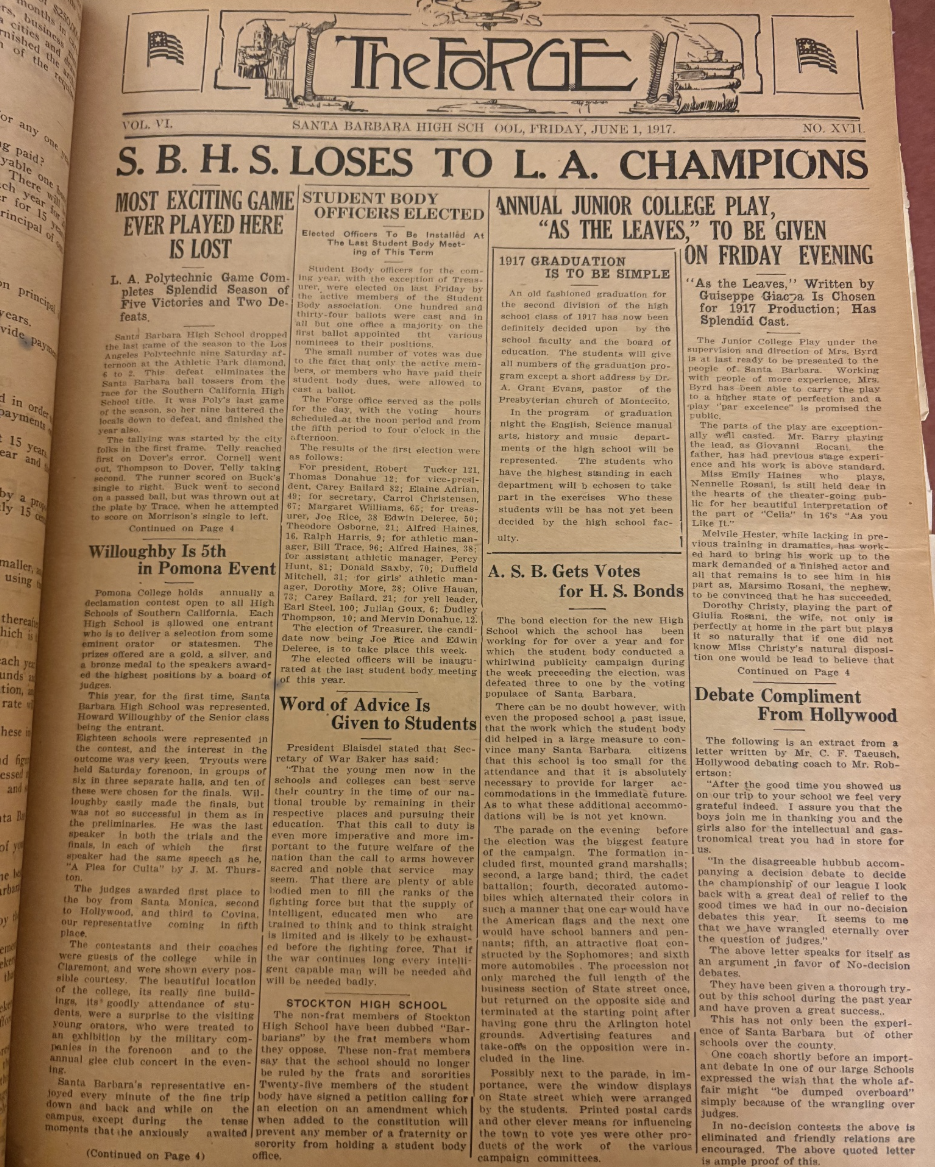







































The concept of the 13th day of any month falling on a Friday is enough to very subtly strike a hint of fear in the back of people’s minds. It injects just a twinge of unease into the air, affecting even the most skeptical of non-believers. Interestingly, the fifth publication this school year of Santa Barbara High School’s (SBHS) very own The Forge falls on Friday, March 13. Does this mean an unreasonable and mysterious taboo? Or is there a traceable and researched explanation? Depending on one’s personal beliefs, it could be both, but there are a few theories regarding the cautionary nature of this superstition.
The fear of the number 13 has become so embedded in society that it has earned its own name: triskaidekaphobia. In many religions, the number 12 is seen as perfect; it appears 187 times in the Bible as well as other religious scriptures, which could explain some of the stigma associated with the number 13: it is seen as breaking or disrupting this perfect number. In the biblical Last Supper, 13 guests were present at the table, including Jesus Christ and his 12 disciples. The Last Supper was held on a Thursday, the day before Christ was arrested and crucified, on a Friday. This is perhaps the most popular explanation for why Fridays and the number 13 are often regarded with hesitancy when they overlap.
A superstition is the belief that certain actions or objects will lead to bad luck or increased fortune. To some, the following of this somewhat mystical concept is nothing more than a quirky personality trait or childish grasp at something almost magical. Others believe that superstition is deeply rooted in the vast unknown of a spiritual and unexplained universe. Despite personal beliefs, research shows that the history of most superstitions can be traced back thousands of years to ancient times and societies, and has roots in religion, folklore, and tradition.
For example, there are a couple of different theories associated with the idea that walking under a ladder will bring bad luck. Of course, it’s common sense that walking under an open ladder, which most likely has somebody working on it, is an accident waiting to happen, which may be a more popular explanation for why so many people avoid this action. However, this commonly followed superstition is believed to have origins in ancient Egypt, where the triangle was considered a sacred shape. Therefore, walking under a ladder – which, standing upright or leaning against a wall, formed a triangle – was seen as disrupting this sacred shape and would bring bad luck.
Knocking on wood to preserve the positivity of an optimistic statement is believed to come from Pagan cultures, most commonly a collection of tribes that originated in central Europe called the Celts. They believed that ancient spirits resided in trees, and knocking on the trunks of these trees was a way to rouse the spirits in order to call on their protection, or show them their gratitude for good fortune. Another theory is that knocking on wood was a way to ward off evil spirits and prevent them from overhearing when one was bragging about their luck. In Christianity, the practice is often linked to the wood from the cross of Christ’s crucifixion.
In ancient Rome, it was believed that mirrors held a part of one’s soul, and breaking one would similarly damage the soul to the point of needing seven years to heal and regenerate, hence the superstition that breaking a mirror will grant seven years of bad luck. Wishing upon a shooting star came from the ancient Greek Astronomer Ptolemy, who believed that shooting stars were gods, spirits, or deities who were more likely to grant wishes at that very moment. Black cats were thought to be companions to witches, which is why crossing their path could be viewed as a negative omen.